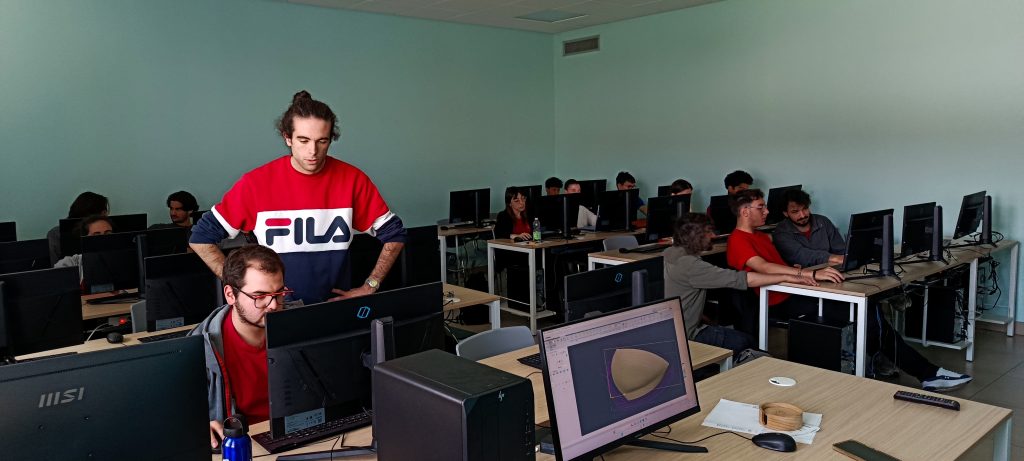
On 12 May 2026, ASLAM hosted the ShiftVET A2.2 Practical Class at the Artwood Academy in Italy, providing students with a hands-on opportunity to apply digital manufacturing technologies in a real vocational training environment.
The practical session brought together 10 students and 2 trainers who participated in a series of workshop-based activities focused on CNC machining, 3D scanning and 3D printing. Unlike introductory technology demonstrations, these activities were designed to strengthen existing technical competences and expose learners to complete digital production workflows used in the wood and furniture sector.
Throughout the day, students rotated between different workstations, gaining experience with advanced manufacturing equipment and software. Participants completed a CNC milling exercise involving pocketing and profile cutting operations, digitised a physical object through 3D scanning, and produced functional 3D-printed connectors for a wooden stool.
One of the most valuable aspects of the practical class was the integration of the three technologies into a coherent manufacturing process. Students were able to understand how digital design, scanning, machining and additive manufacturing can work together to support modern woodworking applications.
The activities also highlighted the high level of technical expertise already present among learners. Trainers reported strong engagement, autonomy and problem-solving skills throughout the sessions, allowing the focus to move beyond basic machine operation towards workflow optimisation, quality control and manufacturing precision.
Feedback from participants was overwhelmingly positive. Students particularly appreciated the opportunity to work directly with industrial-grade equipment and real production scenarios, while trainers highlighted the effectiveness of the exercises in connecting digital design with practical manufacturing processes.
The practical class confirmed the value of ShiftVET’s learning approach and demonstrated how vocational education can successfully prepare future professionals for the digital transformation of the wood and furniture industry.